On Sunday, I try my best to have no obligations. Ideally, it is a day full of wonder and possibilities: good conversation, a board game or two, good reading, good food, a little longer in bed or relaxing on the couch, and so on.
And today was simply one of those good Sundays.
-I received flowers from the Sunday school class because they'd seen that I was walking on crutches.
- An American woman came and sat beside me in church - hearing her "Excuse me" as she went past me into her chair, made me attune to the fact that she might appreciate some help knowing what was going on in the service - and I tried to help her be able to participate somewhat. I always appreciate people who desire to participate in worship in a local church when they're in a different country. I talked to her after the service - she teaches nursing at a Christian University in California (although she's originally from Ontario (she lived practically beside Redeemer College!)) and was here for a conference on the spiritual side of care with regard to nursing. Fascinating.
- And I was actually interested in the sermon (I'm notorious for not listening to sermons). Our church is doing a sermon series on the book of Judges - and it's just such a strange book with so many strange stories, that I can't help but be interested in what the preacher will make of the text.
- And after the service, I had a number of good conversations. I sometimes find it hard to know what to say to people, and it was nice to avoid the awkward 'so we should both say something but what' moments. My foot and crutches make a pretty simple (and obvious) conversation opener.
- The good conversations continued as Matthijs and I sat around in the community. Getting to go there after church and just spend unhurried time there chatting is one of the good things about being back in Amsterdam.
- And Sunday dinner was pizza, wine, salad, and ice cream. With a meal like that, how could it not be a good Sunday?
The rest of the Sunday has simply been spent being thankful. How could I not be?
06 November 2011


02 November 2011
People are fascinating
I remember reading a study years ago about how often people would push the button to open the handicapped-access doors instead of actually physically opening the door. The frequency was surprisingly high. In certain places, this action was so normal that there was actually comments made about how laziness was not actually one of the physical inabilities that would cause one to need to use a handicapped-access door. Discussion also included how opening the doors with the button was a waste of energy for those healthy enough actually to open the doors.
Last Friday I sat in the hall of the Utrecht University waiting for Matthijs. In front of me was one of those buttons - and since it'd been so long since I'd seen such a button to open the handicapped-access doors, I was immediately curious. Who would press the button and who wouldn't?
Many of the students did not, in fact, press the button.... but that's only because one of their friends had pressed it, or someone immediately before them had pressed it.
Of the approximately 20 percent of people who physically touched the doors, more than half of them did so because the door that had previously been open unexpectedly started closing before they were through.
Matthijs came to get me after about 5 minutes (fyi: he did actually open the door physically). I wouldn't say he had to drag me away, but he certainly had to spend some time listening to me enthusiastically talk about the brief scientific study I had done on the door-opening. I have no doubt that I could have cheerfully stayed there for another half hour (and would have succumbed to pulling out on my pen to record things more scientifically). I just find people so fascinating.
29 October 2011
On Becoming Companions (tochtgenoten)
On Monday
evening, Matthijs
and I are taking the step to become tochtgenoten (companions [on a journey]) within Oudezijds100. We are sharing this journey with two
others (Coby
and Marco), alongside of Sjoerd and Dorothea who are becoming postulants.
Becoming a tochtgenoot is not a new step for me: several years ago I also made this step. I even followed that initial step by becoming a postulant. So how do I travel this initial path again and still feel like I am moving forward and growing in community? The simple answer is that the path is not quite the same: every journey is different. More importantly, I am not making the journey without having learned from the last time and grown since I first travelled this path. And I am making this journey once again full of hope.
Becoming a tochtgenoot is not a new step for me: several years ago I also made this step. I even followed that initial step by becoming a postulant. So how do I travel this initial path again and still feel like I am moving forward and growing in community? The simple answer is that the path is not quite the same: every journey is different. More importantly, I am not making the journey without having learned from the last time and grown since I first travelled this path. And I am making this journey once again full of hope.
But what about
these past
two years
as postulant?
Talking too
enthusiastically
about becoming a tochtgenoot seems to
make light
of the
time I
spent as
a postulant.
Or to
question the
goodness of
my desire
two years
ago to
make that
step. In
many ways,
being a
postulant was
good -
I do
not regret
my request
nor my
desire to
share in
the joys
and
responsibilities
of being
part of
the core
group. Yet,
during those
two years,
much changed
both within
the coregroup
and in
my personal
life.
Relationships
were strained,
and it
was hard
to be
fully myself
and to
feel heard. To my disappointment, the original idea I had of the journey that I would follow was no longer possible nor even good.
And so the journey continues now with my becoming a tochtgenoot on Monday. And I am filled with the wonder of being more part of a community and of being able to explore what community life means for Matthijs and me. That community life is for me was something I sensed when my googling a community in Amsterdam so quickly led me to the Oudezijds100 website, and I discovered what I had been looking for before I even knew what it was. And within a short time of being here, I knew that I wanted to live in some kind of community for the rest of my life. It was Matthijs's interest in community that first attracted me to him (the Old Testament part didn't hurt, of course). And as a married person, my desire is still fully to serve God and live out my faith in all that I do. As much as I enjoyed all the time we had together when we first got married and the energy we could put into ourselves and our marriage, there was also a sense of emptiness: shouldn't serving God be more than my academic work and more than my supporting and encouraging Matthijs (and he me)? Where is the rest of the wider church? And where are the other people we are called to love and encourage?
I hope that we can better answer those questions this coming year: not just in the abstract but also in the midst the realness of community: both its joy and its messiness.
23 October 2011
Such a little bone, such a big nuisance
Late Thursday evening, I twisted my foot funny and broke a bone connected to my little toe (I think it was the fifth metatarsal bone in my foot (see diagram of the bones of the foot)). It didn't hurt so much, and I could hobble along and bike, so I went home in the hopes that on Friday morning things would have improved somewhat.
I did manage to sleep well on Thursday night, but otherwise nothing else had improved by Friday morning - in fact, the side of my foot was all bruised and it was at least as swollen as the night before - and hobbling was even more challenging. So, off to the doctors we went (Matthijs was planning on working from home, so he could accompany me) - we went with bikes, actually, since that put the least amount of pressure on my foot.
Several hours later, I came home with a very large cast on my foot - it goes almost to my knee, although my first four toes are exposed. The open toe part is actually quite nice, as I can wiggle my toes and get rid of the funny feeling in my foot - like it's asleep or itchy.
In general, the cast and foot problem is a nuisance. And every so often, I feel a sharp pain when I reposition my foot - I don't think I knew so many muscles were indirectly connected to my foot! I've also discovered new muscles in using crutches and moving around with a broken foot - so I've been walking around a bit tense and sore.
As much as the foot has been a nuisance, it's also been a challenge. I like a good challenge - and figuring out how to shower and cook and move around has definitely been a fascinating puzzle! Of course, laughing at all the dumb things has also been good - like the fact that Matthijs has to get my clothes out for me, since normally I have to stand on the bed to reach them (and I am not the most organised person when it comes to ordering clothes). And it has been good to see Matthijs's recognition of how much work the chores in house are, especially now that he has to do most of them. But on top of everything, I'm deeply thankful for all the support and encouragement I'm getting.
17 October 2011
Weekendje Groningen
We headed out to Groningen this past weekend - just to get away together and explore a part of the Netherlands that I know very little of. Unfortunately, we once again both forgot our cameras. We also both forgot an umbrella, but that was less of a problem, seeing as we were blessed with absolutely gorgeous sunny weather this weekend.
We got to see the house where Matthijs was born: Huize Tavenier, which is a beautiful Art Nouveau style house. It was for mothers healthy enough to give birth outside of the hospital but giving birth at home wasn't so ideal (Matthijs's parents (or just dad?) were still students and lived in a house without hot water). More than 27,000 babies were born here - and I find it unique and fascinating that Matthijs is one of them.
During the weekend, we wandered around a lot, caught up on sleep in our hotel (a great deal including train tickets, although it was in the middle of nowhere), saw a lot of fascinating buildings (Groningen seems to be a mixture of architecture with different styles mixed through each other), got to stop in a few shops (stores close at 17.00 on Saturday and don't open again until Monday morning), and just enjoyed the feeling of being away for a short time. We also got to visit our new niece on the way there and have lunch with an old university classmate from Matthijs.
After Amsterdam, Groningen has the most Amsterdam School Architecture - it's a bit like Art Nouveau but with a lot of rounded corners, bricks sticking out in strange patterns - or placed sideways. Two examples are this city building on Gedempte Zuiderdiep street and
the Oosterkerk that we bumped into on the east side of the city. Both
photos are from Wikimedia Commons, taken by Wutsje.
We also got to attend a church service in the Aa-church, a service that honoured the restoration of the organ and featured two Cantates (including Bach's "Now thank we all our God"). It was the first time in years that there was a service in the church, and it was obvious that everyone wanted to attend the celebration: what was it ever full!! Matthijs and I arrived almost a half hour early, only to see a line-up of people going through the door. They'd printed out 500 copies of the liturgy - and I think everybody was sharing a copy. There wasn't enough room for everyone to sit, even though we were packed into the benches.
After having seen everything in the Guide books that I'd wanted to see, I had only one wish from the weekend left over: to fill myself up on delicious food. And at De Kleine Moghul, this wonderful little Indian restaurant a bit north of the centre, I happily got to fulfill my wish and we could head back home :)
It was a delightful little weekend away (n.b. the ending "je" on a Dutch word makes it a diminutive: thus a weekendje is a short/little weekend): Matthijs and I both enjoyed getting away and exploring. And to make the feeling of vacation last a little bit longer, Matthijs and I have tickets to a concert tonight in the Concertgebouw!
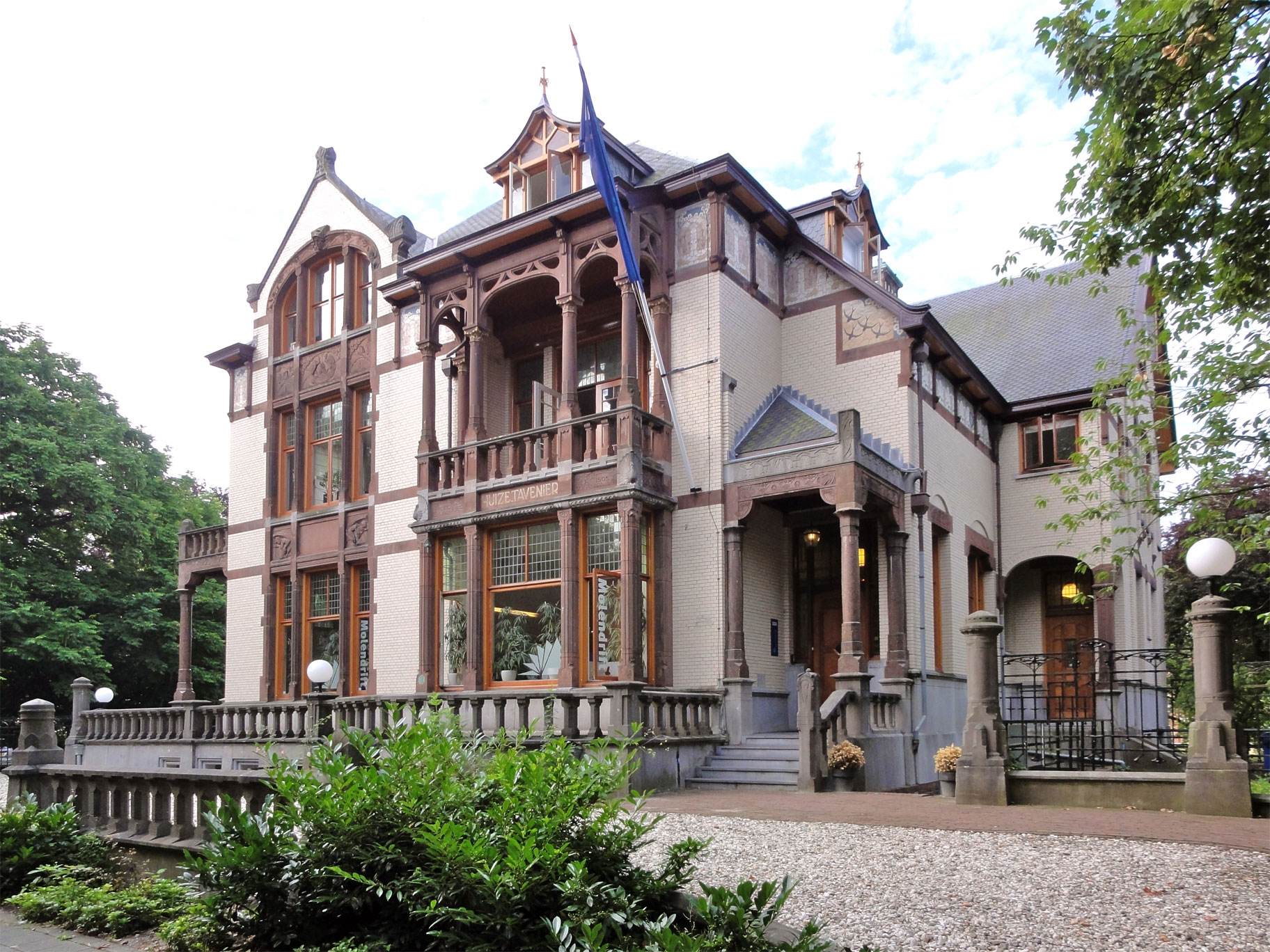 |
| Huize Tavenier |
During the weekend, we wandered around a lot, caught up on sleep in our hotel (a great deal including train tickets, although it was in the middle of nowhere), saw a lot of fascinating buildings (Groningen seems to be a mixture of architecture with different styles mixed through each other), got to stop in a few shops (stores close at 17.00 on Saturday and don't open again until Monday morning), and just enjoyed the feeling of being away for a short time. We also got to visit our new niece on the way there and have lunch with an old university classmate from Matthijs.
 |
| City building 1928 near the Groninger Museum |

 |
| Oosterkerk - a Gereformeerde Church |
We also got to attend a church service in the Aa-church, a service that honoured the restoration of the organ and featured two Cantates (including Bach's "Now thank we all our God"). It was the first time in years that there was a service in the church, and it was obvious that everyone wanted to attend the celebration: what was it ever full!! Matthijs and I arrived almost a half hour early, only to see a line-up of people going through the door. They'd printed out 500 copies of the liturgy - and I think everybody was sharing a copy. There wasn't enough room for everyone to sit, even though we were packed into the benches.
After having seen everything in the Guide books that I'd wanted to see, I had only one wish from the weekend left over: to fill myself up on delicious food. And at De Kleine Moghul, this wonderful little Indian restaurant a bit north of the centre, I happily got to fulfill my wish and we could head back home :)
It was a delightful little weekend away (n.b. the ending "je" on a Dutch word makes it a diminutive: thus a weekendje is a short/little weekend): Matthijs and I both enjoyed getting away and exploring. And to make the feeling of vacation last a little bit longer, Matthijs and I have tickets to a concert tonight in the Concertgebouw!
14 October 2011
Does one ever become integrated into a society?
I wrote the following article for catapult magazine asking about whether one ever becomes integrated into a different culture.
The link is available here: The Integration Issue.
With thanks on Hermen Jan and Joan for the conversation and their ideas.
"Recently a group of us were sitting around when an Albanian friend of mine asked a Dutchman when he’d be considered “to be integrated” into Dutch society. Was it when he acquired a taste for buttermilk (karnemelk)? Was it when he spoke Dutch fluently?
My Dutch friend had no answer. Instead, he had two examples, neither of which fully answered the question. The first was the example of a teenager born in Amsterdam to a couple who’d moved here from Morocco. The teenager speaks Dutch with a classic Amsterdam accent and has attended Dutch schools, absorbing Dutch culture in all that he has learned outside of his house. Yet, at home, he has been schooled in the tradition and religious values of his parents. When, as a teenager, he cannot resolve the tension between these two cultures he rebels and causes tension in society, it is often seen as an example of someone who has not integrated well into Dutch culture.
The second example was that of the Chinese communities around the corner, who have been in the Netherlands almost a hundred years and have successfully set up a thriving business community of restaurants and supermarkets. They spend most of their time in their own company and marry amongst themselves; some still speak barely a word of Dutch. Nonetheless, there are no questions raised about whether these Chinese are fully integrated into society here, despite the (historical) involvement of the Chinese with heroine use.
The conclusion I came to was that there is no answer to the question of when one truly belongs. Even the question itself of when one becomes integrated depends on one’s culture. Is it having a passport, speaking English (or French), and being able “to make it on one’s own,” which are some of the unwritten assumptions of integration in both America and Canada? Does someone only belong if she is born somewhere, as is true in Albania, where integration, like immigration, does not really happen? Or does belonging come through being a positive part of society, which means that those holding on to different values need to suppress them so that they do not burden the society, as in the tensions mentioned above? What is integration, after all, besides simply a word that became popular when discussing how certain groups in society did not seem to fit in? It is a vague cultural concept that describes society, like American’s melting pot or Canada’s multi-cultural mosaic; it is a term that is hard to translate into the practical reality of everyday life.
The comment about acquiring a taste for buttermilk was sarcastic; yet, the question of belonging was real. Despite the fact that many Dutch people will never acquire a taste for buttermilk, they will still be considered insiders. And yet, because I grew up in Canada, my disgust for it marks me as an outsider, even though I have Dutch parents and a Dutch passport. No matter how much my parents and grandparents passed on their dutchness, I grew up in a land with different customs and I will always have an accent when I speak Dutch. Yet, the longer I stay in the Netherlands, the more my English develops a certain accent and the more I adapt to the culture here.
The less I feel like an outsider here in the Netherlands, the more I become aware of being an outsider in a world where I used to belong. This adapting and changing often causes me to feel permanently like an outsider, even though I have close family and wonderfully supportive faith communities in both places. The feeling of being an outsider makes me ask sometimes if it is worth it, and whether it would not be better to reject one culture to become more settled in another. However, I know I would feel a sense of loss in making that choice. The attempt to serve God faithfully in a new and different place among people of a (slightly) different culture, alongside the attempt to see the sinful blind spots of one’s own culture and delight in the God-given good in each culture, is worth the discomfort. It also increases my awareness of the reality that culture is hardly uniform: each community and family has a bit of a different culture with differing values and unspoken rules. Thus, simply interacting with others is an act of one outsider talking with another outsider. The question I am now learning to ask myself is not how I can become more integrated and stop being an outsider, but instead how I can learn to live with my discomfort while delighting in God’s image in the other, a truth that makes both of us “insiders.”
The link is available here: The Integration Issue.
With thanks on Hermen Jan and Joan for the conversation and their ideas.
09 October 2011
The church as dynamite
As part of my desire to grow further in my understanding of what "community" is, I've read some books about Dorothy Day, who started the Catholic Worker Movement. From what I've read, it is obvious that she desired to serve God fully in all of what she said and did - and she did so with much faith, passion and a good dose of stubbornness (although I expect the stubbornness sometimes irritated those who worked with her, I also expect that God worked at times through her stubbornness - and at times despite it). Also admirable was her love for the church and her desire to be fully committed to the Catholic Church while also challenging the viewpoints within the church that she found to be contradictory to the church's message - this was most obvious in her stands on both pacificism and social activism.
A key partner in her work was Peter Maurin - who was famous for his "Easy Essays." They are short poems which get one to thinking. The first one that got me to thinking was his own challenge to the church - a challenge to wake up and be relevant. It is, I believe, a challenge that is still needed today - and not just for the Catholic Church.
"Blowing the dynamite"
Writing about the Catholic Church,
a radical writer says:
"Rome will have to do more
than to play a waiting game;
she will have to use
some of the dynamite
inherent in her message."
To blow the dynamite
of a message
is the only way
to make the message dynamic.
If the Catholic Church
is not today
the dominant social dynamic force,
it is because Catholic scholars
have taken the dynamite
of the Church,
have wrapped it up
in nice phraseology,
placed it in an hermetic container
and sat on the lid.
It is about time
to blow the lid off
so the Catholic Church
may again become
the dominant social dynamic force.
Taken from pages 12-13 in Mark and Louise Zwick's The Catholic Worker Movement (Paulist Press, 2005).
As one who does theology, this poem is a good warning to all of us who are involved in things having to do with theology, church, and the Bible. It is so easy to get up in details or facts and to forget that my serving God isn't so much about getting the information right so much as it is about doing theology or church (or read the Bible) in a way that makes a difference in all of life - both personal and public - and helping/teaching others to do the same.
Subscribe to:
Posts (Atom)